Eye strain in children: signs, causes, and quick fixes
The eye rubbing after a long cartoon, the 'my eyes are tired'. Here's what digital eye strain in children actually is, why it happens, and the small fixes that help.
On this page
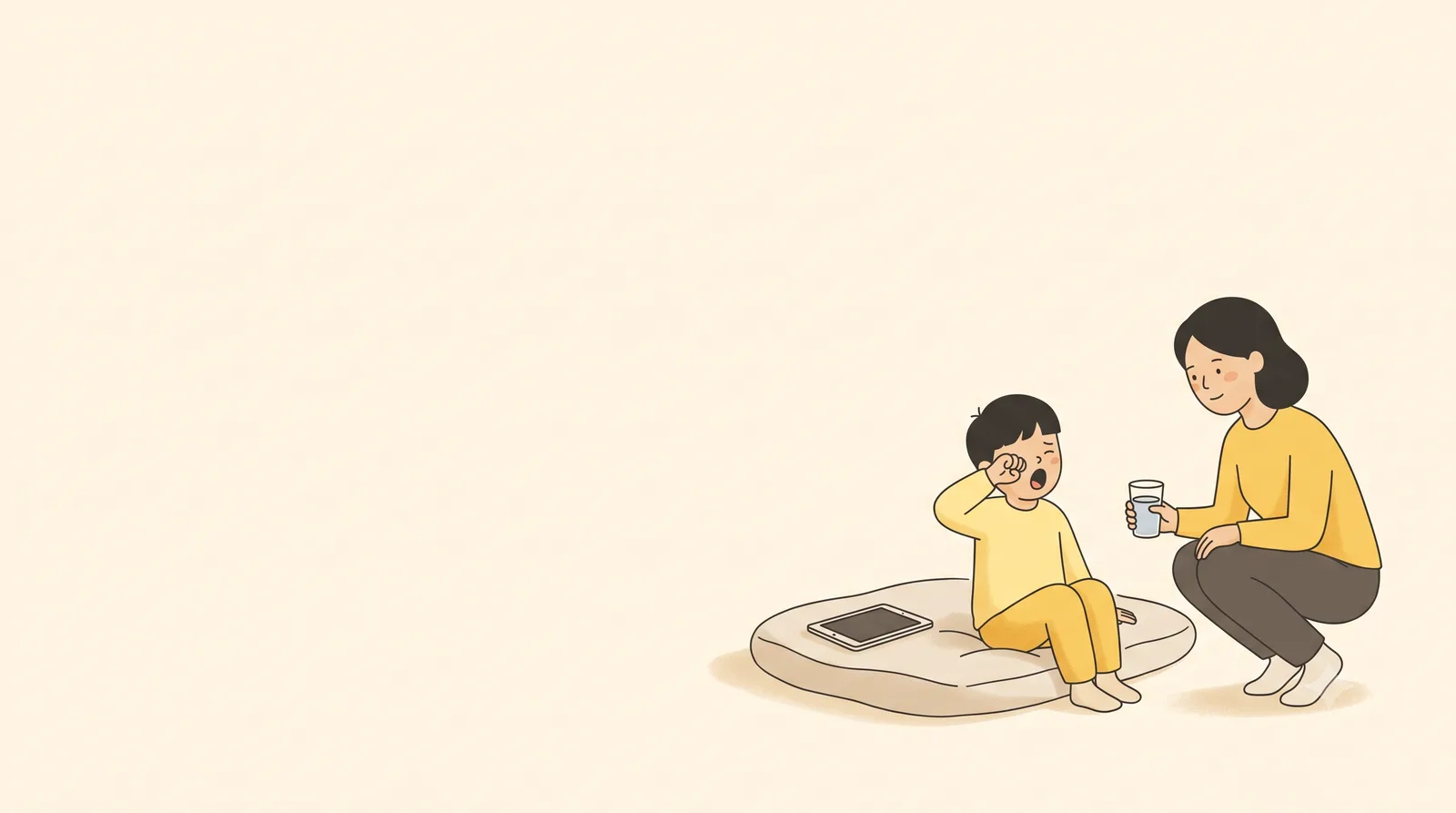
Your child finishes a long stretch on the tablet, looks up, and starts rubbing their eyes with both fists. They squint a little at you across the room. "My eyes feel tired," they say, or maybe they just go quiet and grumpy. You've seen it before. Usually it passes in a few minutes.
That feeling has a name. Eye doctors call it digital eye strain, or sometimes computer vision syndrome, and in a child it tends to show up not as a clear complaint but as a handful of small habits after screen time. Rubbing. Extra blinking. A headache they can't quite explain. Sitting closer and closer to the screen.
The reassuring news first. Digital eye strain is real, but it isn't an injury. As the American Academy of Ophthalmology puts it plainly, these symptoms "are temporary and no permanent damage is being done to the eyes." They come on after a long session and ease off once the eyes get a rest. Below is what's happening behind those tired eyes, and the small fixes that help.
What is digital eye strain in children?
The American Optometric Association describes computer vision syndrome as the group of eye and vision problems that comes from long stretches looking at screens, phones, tablets and the rest. The common symptoms it lists are eyestrain, headaches, blurred vision, dry eyes, and neck and shoulder pain.
In grown-ups, those symptoms get noticed and named. A child doesn't have the words. So eye strain in a young child looks more like behaviour than a symptom: the eye rubbing, the squint, the "I don't want to read any more".
Children are also a little more exposed to it. Their visual system is still developing, and many don't notice, or don't say, when their eyes are working too hard. They keep going until something makes them stop. Which is why a parent often spots the strain first.
What are the signs of eye strain in a child?
The signs are quiet, and they cluster around screen time rather than showing up out of nowhere. A few worth knowing.
Rubbing the eyes after a stretch on a device. Tired, dry eyes feel itchy, and a child who can't say "my eyes ache" will rub instead.
Blinking a lot, or hard, or complaining that things look a bit blurry just after they look up from the screen. The blur is usually brief. The AAP explains that gazing at the same distance for a long time can leave the focusing muscle slow to "let go", so the world looks soft for a moment when the child shifts their gaze.
Headaches or "tired eyes" that turn up after close work and fade once the screen goes away. The American Academy of Pediatrics makes the point simply: the muscles around the eye, like any others, get tired from continued use.
Sitting closer and closer to the screen as the session goes on, or holding the phone right up by their face. Sometimes that's just a comfy habit. Sometimes it's the eyes trying to make a tiring task a bit easier.
None of these on its own is a worry. It's the pattern, the rubbing and the squint and the "my eyes hurt", showing up together after screens and easing off after a break, that points to ordinary eye strain.
What causes eye strain in children?
Four things, mostly, and they pile on top of each other.
The big one is sustained near focus. Looking at something close holds the eye's focusing muscle in a flexed state, and holding any muscle flexed too long makes it ache. A child curled up with a tablet for an hour is asking that tiny muscle to grip the whole time. The AOA notes the focusing and eye-movement demands of screen viewing "can place additional demands on the visual system".
Then there's distance. The closer the screen, the harder the eyes have to pull to focus, so a phone held a hand-span from the face is more tiring than the same video at arm's length. The AAO's advice for kids is to keep the device "an arms length away and at a slight downward angle from your child's face".
Third, less blinking. We blink far less when we're absorbed in a screen. The AAP cites studies showing that staring at a screen "can cut blinking rates by half", which dries the eyes out and leaves them gritty and irritated. Young children, lost in a cartoon, can go a long while barely blinking at all.
And glare. Reflections on the screen, a bright window behind it, harsh overhead light, all of it makes the eyes work harder to see clearly. The AOA flags glare and reflections as a direct cause of strain, and suggests positioning the screen "to avoid glare, particularly from overhead lighting or windows".
What are the quick fixes for eye strain in kids?
Most of it is small and free. The aim is just to give those focusing muscles a regular rest, keep the eyes moist, and stop the screen sitting too close in too much glare.
Take breaks from near focus. The most quoted version is the 20-20-20 rule: every 20 minutes, look at something at least 20 feet away for about 20 seconds. Both the AOA and the AAP recommend it. A young child won't follow a clock, so skip the exact numbers; just build in regular "look out of the window" moments. We go into pre-reader-friendly versions of it in the 20-20-20 rule for kids. The AAP adds a bigger break too: walking away from the screen for at least 10 minutes every hour.
Mind the distance. A screen held too close is one of the biggest drivers of strain, and it's the easiest to overlook because a young child's eyes can focus up close without obvious effort, so they don't feel the cost until later. Arm's length for a tablet, a bit closer is fine for a small phone, but a hand-span from the nose is too close for a long sitting. Keeping that comfortable gap is partly what our pillar guide on safe screen distance for children is all about.
This is the one fix that's hard to police minute by minute, because the screen creeps closer the moment your back is turned. It's the gap a tool like Guby is built to mind: it uses the phone's front camera, entirely on the device, to sense when the screen has drifted too near a child's face, and a friendly owl gently covers the screen until they ease back. Nothing recorded, nothing sent. In a dimly lit room it also softens the screen, prompting the phone's night-light setting where there is one or laying down its own warm tint as the light drops, so an evening screen isn't glaring white in the dark. One quiet help among the rest here, not a replacement for the breaks and the daylight.
Sort out the light. Position the screen so there's no window or bright lamp reflecting off it. Match the screen's brightness roughly to the room, rather than a bright screen glowing in a dark room or a dim one washed out by sunlight.
Encourage blinking. You can't really order a child to blink, but a reminder to "give your eyes a big blink" during a break helps, and so does the break itself, which naturally resets the blinking.
Get them outside. Time outdoors gives young eyes a proper chance to focus far away and relax that near-focus muscle, the opposite of screen work. The AAP calls outside play "a great 'workout' for children's vision". As a bonus, daylight is also linked with slower progression of short-sightedness, which is a separate, longer-term reason to value it.
When is it more than eye strain?
Here's the line to hold in mind. Ordinary digital eye strain comes on after screens and goes away with a rest. If the tired eyes, the blur, the headaches keep up even when your child hasn't been on a screen, or don't settle after a proper break, that's worth a closer look, because it may not be strain at all.
A child who always sits close, squints at the television across the room, tilts their head to see, or loses their place when reading may be doing it because that's the only way things look clear to them, not because of a long cartoon. Those are signs of a refractive error, the kind of thing glasses fix, and they're a separate matter from screen strain. We cover them in signs your child might need glasses.
Either way, the honest move is small: book a proper eye exam. The AOA suggests a thorough eye check between the ages of 3 and 5, and another around the time a child starts school, even with no warning signs at all. If something's bothering you sooner, don't wait for a milestone. In India that usually means a paediatric ophthalmologist or an optometrist who sees children, and a paediatrician can point you to a good one. Elsewhere it's much the same.
This isn't medical advice, and a blog can't examine your child. If the tired eyes worry you, the squint won't settle, or you just want peace of mind, talk to your child's eye doctor. That's the one step a website can't do for you, and it's nearly always a reassuring afternoon.
Found this useful?
Send it to a parent who’d want it.
Related reading
A parent's guide to children's eye check-ups: when, where, what happens
When should a child's eyes be checked, and how is a real exam different from the screening at school? A plain guide to the schedule, what happens, and the signs that mean go sooner.
children's eyes · eye health
The 20-20-20 rule: does it work for young children?
Every 20 minutes, look 20 feet away for 20 seconds. Sound advice for an adult at a desk. But can a four-year-old who cannot read a clock actually follow it?
children's eyes · eye health · screen time