How far should a phone be from your child's face?
Eye doctors suggest keeping a phone at least an arm's length from a young child's face. Here's why little ones hold screens so close, what it does over time, and small fixes that actually help.
On this page
- What do eye doctors actually recommend?
- Why do kids hold the phone so close?
- Does the right distance change as they grow?
- What happens if it stays that close?
- Distance or screen time, which matters more?
- What can you do about it at home?
- What if your child won't keep it back?
- What about books and the TV?
- A note for real, busy homes
Quick answer: Keep a phone at least 30 cm — about an adult's arm's length — from a young child's eyes, and tablets a little further. Small children naturally pull screens in close; the fixes are small (the "elbow rule," a phone stand, and gentle reminders), and Guby nudges that healthy distance automatically on Android.
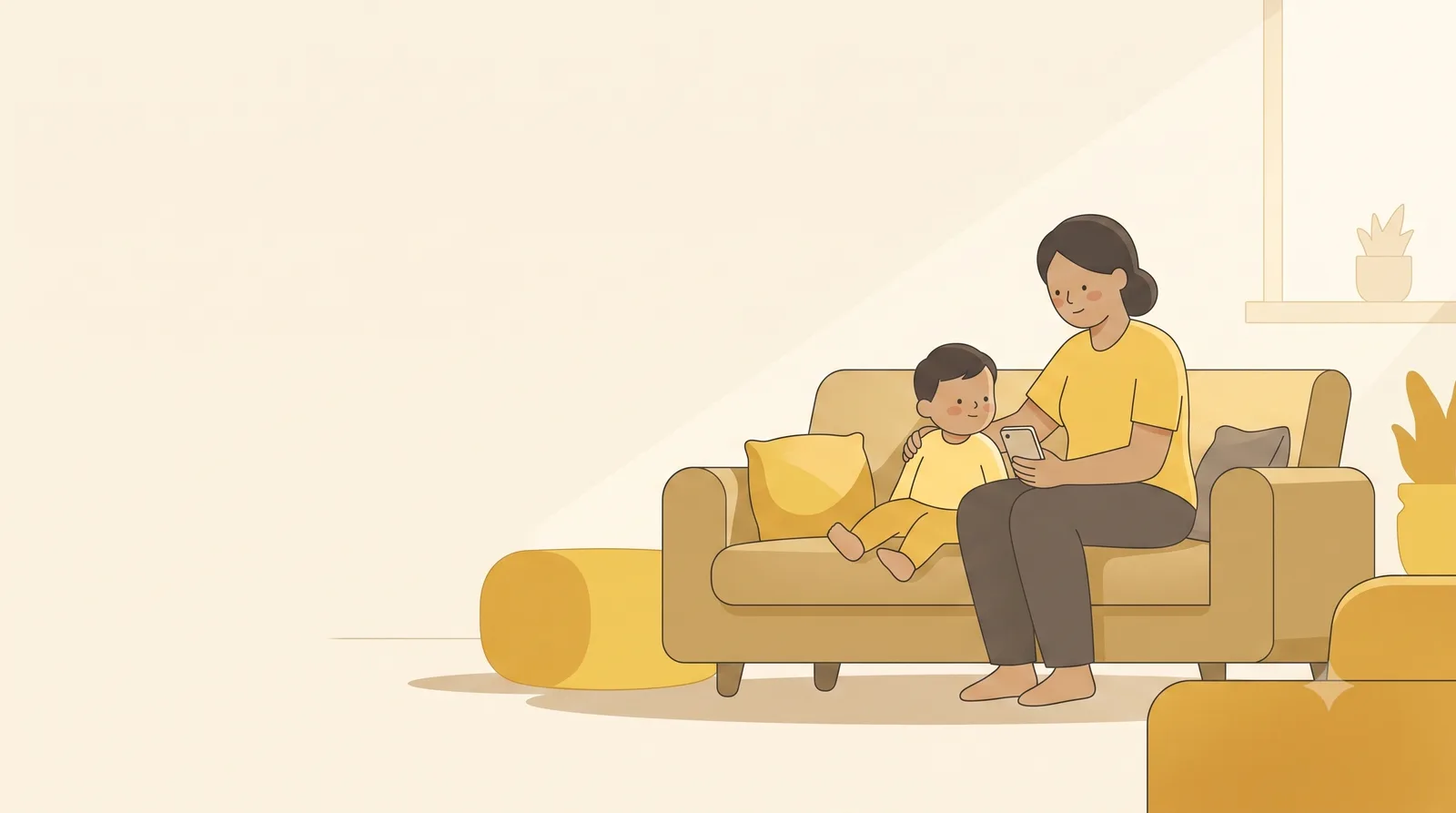
You hand your three-year-old the phone for ten minutes so you can finish a call. Next time you look up, her nose is almost on the glass. You move it back. She pulls it close again. The video keeps playing, and the two of you do this little dance until the call ends.
If that's familiar, relax. You haven't done anything wrong, and neither has she. Small children hold phones close for reasons that have nothing to do with carelessness, and once you know what they are, the fixes turn out to be small.
What do eye doctors actually recommend?
Most eye doctors (ophthalmologists) suggest keeping a phone at least about 30 cm from the eyes. That's roughly the length of an adult forearm. Tablets a little further again, since the screen is bigger and we naturally sit back from them.
The 30 cm figure isn't plucked from the air. It's the same threshold Apple picked for its Screen Distance feature, and it matches an old optometry guide called the Harmon distance, the span from your elbow to your knuckles. An arm's length, more or less.
There's a simpler version that a lot of parents arrive at on their own. Call it the elbow rule. If your child can hold the phone with their elbow resting easily against their side, the screen is usually far enough away. The moment it creeps in towards the face, the elbow lifts and folds. That's your cue.
Why do kids hold the phone so close?
A few honest reasons, and not one of them is bad behaviour.
The obvious one is size. A young child has short arms, so even a relaxed, ordinary grip brings the screen closer to their eyes than the same grip would for you.
Then there's focus. Young eyes can hold something sharp at very close range without the strain you would feel doing the same thing, so "too close" simply doesn't register as uncomfortable for them.
And then attention takes over. When a child is properly lost in something, the room goes quiet around them, and so does any sense of where the phone actually is. They aren't tuning you out on purpose. They genuinely haven't noticed it has wandered up to their nose.
If you want the fuller developmental picture, including how much focusing power a young eye really has and when close holding is worth mentioning to a doctor, we've gone deeper into why toddlers hold the phone so close.
Does the right distance change as they grow?
Not really. An arm's length is a fair target whether your child is two or eight. What changes is how much of the work falls to you.
A two-year-old can't judge distance, won't sit still for a stand, and has no idea why any of this matters. At that age it's almost entirely on the adult in the room. By six or seven, a child who has grown up with the elbow rule can start to catch themselves and move the phone back without being told. That shift, from you doing it to them doing it, is the whole game.
This is also, honestly, why distance apps tend to focus on the two-to-eight range. Very young faces are hard for a front camera to measure reliably, and older children usually respond better to a real conversation than to a gentle nudge. The middle years are the sweet spot, when a small reminder lands and a habit can actually take root.
What happens if it stays that close?
For a ten-minute video here and there, honestly, not much. Eyes are tougher than we give them credit for, and one close session won't do harm.
What matters is the pattern, not the afternoon. Long stretches of very near focus tire the eyes out, and that tiredness shows up in small ways: extra rubbing, more blinking, a child who turns grumpy the second screen time ends. If those are the signs you keep noticing, we've written separately about eye strain in children — what it is, and the small things that settle it.
Stretch that over years instead of days, and a lot of close-up "near work", screens included, is one of the things researchers connect to rising short-sightedness, or myopia, in children. It isn't the only thing. Genes count for a great deal, and so does time spent outdoors. But distance is one of the few levers a parent can actually reach for, which is exactly why it earns a bit of attention. If a prescription has already arrived and the eye doctor has started talking about drops or special lenses, myopia control for children explains those options in plain language.
So the occasional nose-to-screen moment is fine. A daily habit of it is worth gently steering.
Distance or screen time, which matters more?
A fair question, and the honest answer is both, for different reasons.
Distance is about how hard the eyes work in the moment. Close, sustained focus is the tiring part, and it's the part most tied to that near-work worry. Total time is the wider picture. The World Health Organization suggests almost no screen time for under-twos, and no more than an hour a day for two-to-four-year-olds, less if you can manage it. Past that age the official advice quietly changes shape — we've unpacked it in how much screen time for a 6 to 8 year old.
Here's the reassuring bit: you don't have to pick. They pull in different directions, so improving one doesn't cost you the other. And if you can only change one thing this week, distance is the easier win. It asks nothing of your routine. It isn't less screen time, just better screen time, which is a much smaller ask on a hard day.
What can you do about it at home?
You don't need to hover over every minute. A handful of small changes do most of the work.
- Prop it up. A cheap phone stand, a cushion, a book leaned against something, anything that parks the screen further back and keeps it there. Far less tiring than reminding a child every two minutes.
- Set it up right on day one. If a new tablet is about to arrive in the house, that first evening is the easiest moment to settle all of this at once, before any habits form: setting up your child's first tablet walks through where it should sit, which settings are worth changing, and the bedtime cut-off.
- Turn the elbow rule into a game. "Elbows in, screen back" is something a four-year-old can feel and repeat. "Hold it further away" is not.
- Build in breaks. Every fifteen or twenty minutes, give them a reason to look up, stretch, or glance out of a window. The eyes get a rest from all that close work.
- Get them outside. This one is bigger than screens. Children who spend a couple of hours a day outdoors are meaningfully less likely to become short-sighted, whatever else fills their day. It's one of the steadiest findings in the whole field, and the one we'd point a worried parent at first: outdoor time and your child's eyesight covers what the two-hour rule really asks of you, and how families fit it in.
Devices chip in a little too. On an iPhone, Apple's Screen Distance covers the screen when the phone gets too close, though the warning it shows is text, which a child too young to read can't make sense of. On Android, our own app, Guby, was built for exactly that age. Instead of words, a friendly owl turns up and gently covers the screen when the phone comes in too close, then steps aside the instant your child moves it back.
Treat any of these as a nudge, though, not a cure. The habit your child builds at home outlasts any single feature.
What if your child won't keep it back?
Some children shove the phone straight back to their nose the second you move it. A few will dig in and make a whole thing of it. That's normal, and you can work around it.
Take the argument out of the moment. A stand does this quietly, because there's nothing left to push against, the screen simply stays where it is. If you're holding the line by hand, pair "screen back" with something your child already enjoys, the elbow game, a quick countdown, rather than a flat "no".
And mind your timing. The middle of a favourite episode is the worst possible moment to introduce a new rule. Tie it to a fresh start instead, a new video, a new sitting at the table. Children take a rule far more easily at the beginning of something than halfway through it.
What about books and the TV?
The same idea stretches well beyond phones. A book held an inch from the face is close work too, and it deserves the same gentle "move it back a bit". Reading and drawing are wonderful. They just don't need to happen at point-blank range. If you want the elbow trick that sizes itself to your child, and a homework corner that keeps the page back without any reminding, reading distance for kids covers books, tablets and homework properly.
The television is the opposite problem. It wants distance, not closeness. Across the room is exactly right, and a child curled up a foot from the screen is worth steering back to the sofa. If you want the actual numbers for your room and screen size, and what the old "you'll ruin your eyes" warning got wrong, how far should a child sit from the TV? goes through it properly. One thing to notice, though: a child who has to sit very close to make out what's on the TV may not be choosing to. Sometimes that's an early hint that their eyes need checking. If it's been a while since anyone looked properly, a parent's guide to children's eye check-ups sets out the schedule and what an exam is actually like for a child far too small to read a chart.
A note for real, busy homes
Most screen-distance advice quietly assumes a calm house, one child, and plenty of help on hand. Real life is rarely that tidy.
When both parents work, when the commute eats the evening, when meals happen in shifts and there's nobody free to step in, the phone is often the thing that buys you twenty quiet minutes. (In plenty of Indian homes, where the day runs busy from dawn and grandparents pitch in where they can, that's simply how it goes.) There's nothing to feel guilty about there.
The goal was never zero screens. It's slightly better screens. A phone propped on the dinner table, an arm's length from a small face, is a change that costs nothing and slots into a real, hectic evening. If you want the whole set of small habits on one page, from outdoor light to the screen-free wind-down before bed, the healthy-screen-habits checklist for kids gathers them up.
One last thing. If your child squints, rubs their eyes a lot, or has to sit very close to see the television, mention it to an eye doctor, screens or no screens. Those can be early signs worth a look, and a first proper eye check somewhere around age three is a sensible habit on its own.
Mostly, though, this stays gentle. Move the screen back to about an arm's length. Make that the easy default with a stand. Let the odd close-up video go. Little eyes do a remarkable amount of growing in these years, and a bit of distance goes a long way.
Found this useful?
Send it to a parent who’d want it.
Related reading
The healthy-screen-habits checklist for kids
Seven small habits that protect young eyes, from arm's length to outdoor light to the screen-free wind-down before bed. A checklist you can actually keep.
children's eyes · screen time · screen distance

Reading distance for kids: books, tablets, and homework
Holding a book too close strains young eyes the same way a phone does. A simple elbow trick keeps the right distance, no measuring tape required.
children's eyes · screen distance