Why does my child hold the phone so close to their face?
Short arms are only part of it. Young eyes can focus crisply at a few centimetres without any strain, so close just doesn't feel close to them yet.
On this page
You hand your four-year-old the phone for two minutes of a song, turn to the kettle, and by the time you look back the screen is practically resting on his nose. You move it away. Thirty seconds later, it has crept right back. You're not imagining the pattern, and you're not the only parent who finds it a little unnerving.
The instinct is to wonder whether something is wrong with his eyes. Usually nothing is. Small children hold screens close for reasons baked into how a young eye works, and once those reasons make sense, the worry softens into something more like patience.
So here is the proper answer, the one that goes past "her arms are short". The arms are real, but they're the least interesting part of it.
Why can my child focus on something so close up?
Start with the bit most parents have never been told: a young child's eyes are far better at focusing up close than yours are.
The eye focuses by changing the shape of its internal lens, a trick called accommodation. Tiny muscles squeeze the lens fatter to pull near things into focus, and relax it flatter for distance. The American Academy of Ophthalmology describes this as the eye learning "to quickly change focus between distances". That focusing power is measured in dioptres, and here's the striking part: children have a huge amount of it.
A pooled analysis in the British and Irish Orthoptic Journal put the measured amplitude of accommodation in six-year-olds at around 15 dioptres, easing to about 13 by age ten. Run that through the optics and roughly 15 dioptres means a child can hold something sharp at about seven centimetres from their eyes, with no blur and no effort. An adult, whose lens has stiffened with age, would be straining and seeing fuzz at that range.
That is the heart of it. When a child brings the phone right up to their face, the picture stays perfectly clear and comfortable. There's no ache, no blur to tell them they've gone too far. To a young eye, seven centimetres simply isn't "too close". It's just where the phone happens to be.
The AAO's own list of things to know about children's eyes makes the same point another way: most school-age children are a little farsighted, yet "children generally can accommodate by using their focusing muscles to see clearly near and far". Their focusing system is doing exactly what it's built to do. A bit too well, for our purposes.
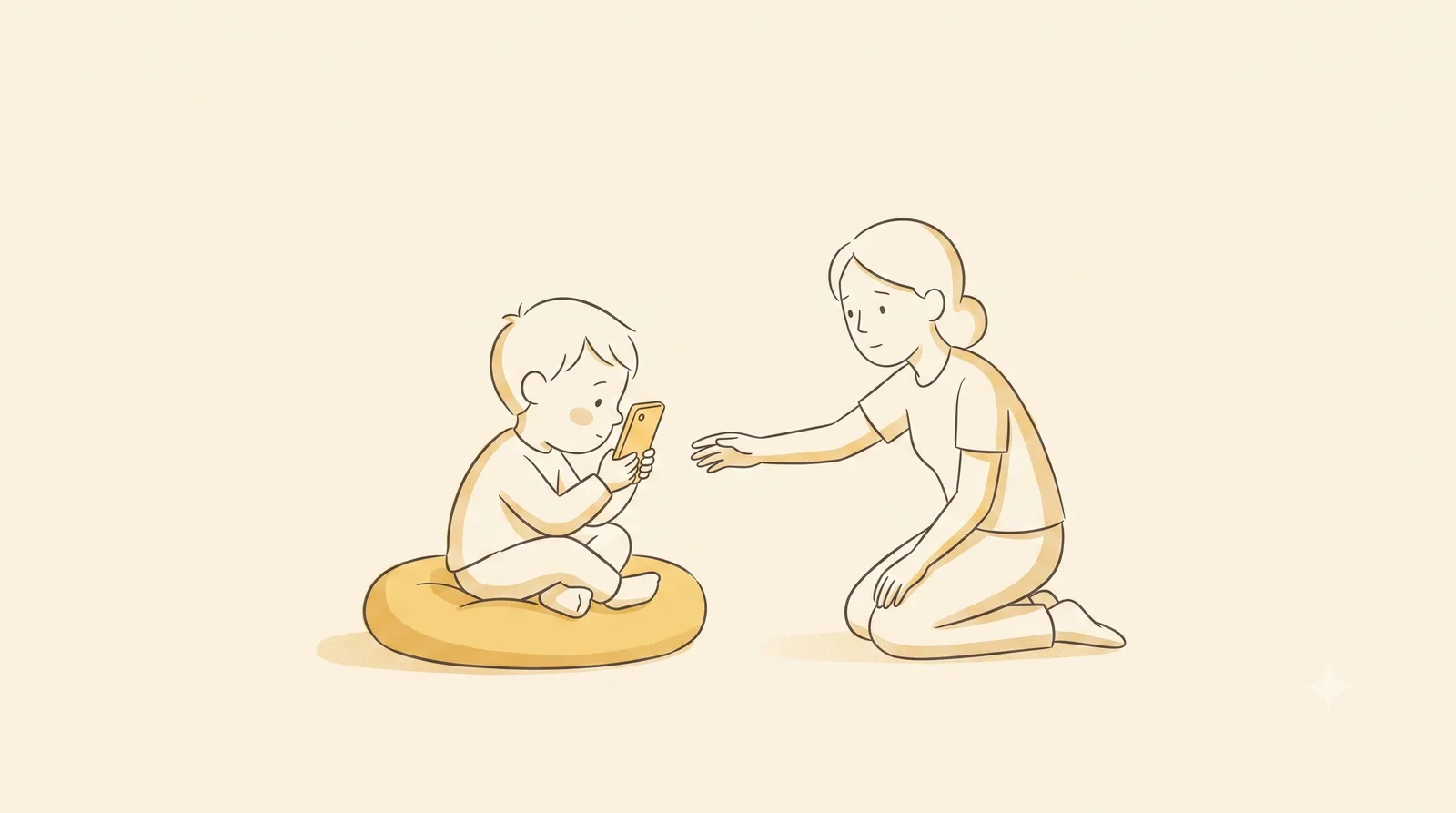
So is it just because their arms are short?
Short arms are real, and they do matter, they're just not the whole story.
Think about how you hold a phone yourself. A relaxed elbow, forearm at a comfortable angle, and the screen lands around thirty to forty centimetres away without you ever measuring it. A three-year-old makes the exact same relaxed gesture. But their forearm is a fraction the length of yours, so the very same posture parks the screen far nearer their face.
Nobody is doing anything wrong. The child isn't leaning in, and you haven't taught a bad habit. The geometry of a small body just delivers the screen closer, and because that closeness feels fine to a young eye, nothing in the child pushes back against it.
Put the two together and you get the behaviour you keep seeing. Short arms bring it close; a powerful focusing range keeps it comfortable there. Together they make "too close" the path of least resistance.
Why doesn't my child notice the phone has crept closer?
There's a third ingredient, and it has nothing to do with eyes at all. It's attention.
When a small child is properly absorbed in something, lost in a nursery rhyme, hunting for the next sticker, the rest of the room genuinely fades out. The hand drifts. The shoulders curl in. The screen wanders up toward the face by slow degrees, and the child has no idea it's happening, because every scrap of their attention is on what's on the screen, not on where the screen is.
This changes how you respond. A child who keeps inching the phone closer isn't being defiant or ignoring you; they have simply gone somewhere else for a minute, and minding the distance of the thing in their hands is not what a four-year-old's brain does in the background. It's the same reason "sit back a bit" works for ten seconds and then quietly undoes itself. So nagging rarely fixes this, and the steadier fixes are the ones that don't depend on the child remembering anything.
When is holding the phone close completely normal, and when is it not?
Most of the time, close holding is just those three things stacked up, and there's nothing to act on beyond gently resetting the distance. But there is a version that's worth a second look, and the difference between them is usually about choice.
A child who can happily see from a normal distance, and only drifts in when they're deep in something, is almost certainly fine. Move them back and they're perfectly content out there; they just don't stay put. That's ordinary.
The pattern to pay attention to is the child who seems to need to be close. The one who shuffles right back up every time, who holds books and toys unusually near as well as screens, or who can't comfortably make out something across the room. The American Optometric Association lists "sitting close to the TV or holding a book too close" among the everyday signs worth checking in a preschooler, alongside squinting, a frequent head tilt, lots of eye rubbing, or turning or covering one eye.
One sign on its own, on one tired evening, means very little. It's the persistent pattern, or a few of these together, that's worth a mention to an eye doctor. We've written more about the everyday signs a child might need glasses if you want the fuller picture.
This isn't medical advice, and you can't diagnose it from the sofa. If something feels off, the honest move is a proper eye exam rather than a school screening, which can miss a lot. Even with no warning signs, the AOA suggests a thorough exam between ages three and five, before school starts. If you're already noticing something, you don't have to wait.
What actually helps a young child keep their distance?
Knowing the why points straight at what works. Since a child can't feel "too close" and won't remember a rule mid-cartoon, the useful fixes are the ones that carry the load for them.
Hold the phone yourself for the very young, where you reasonably can, and you've solved the geometry problem at a stroke; your arm sets the distance, not theirs. A simple stand does a similar job for a tablet, parking the screen at a fixed, sensible range so it can't migrate up to the face. Good light helps too, since a child peering at a dim screen in a bright room will naturally lean in. And shorter sittings leave less time for the slow creep to happen.
There's also a gentle bit of technology for the in-between moments, when you can't hold the phone and the child is too young to self-correct. Guby is a free Android app that uses the front camera to sense, on the device itself, when the phone has drifted too near a child's face. A friendly owl then slides across to cover the screen, and steps aside the moment the child leans back, so the lesson lands in the only language a small child reliably understands: the fun pauses when the phone is too close, and resumes when it isn't. Nothing is recorded or sent anywhere; it just minds the distance so you don't have to say "sit back" for the twentieth time. The longer picture of what counts as a safe distance, and why it matters as eyes develop, is in our guide to safe screen distance for children.
None of this needs to be a battle. Your child isn't holding the phone close to defy you, or because their eyes are failing. They're doing it because, to a young eye, close feels perfectly fine, and the most loving thing you can do is set the distance for them while their own sense of it is still growing in.
Found this useful?
Send it to a parent who’d want it.
Related reading
The healthy-screen-habits checklist for kids
Seven small habits that protect young eyes, from arm's length to outdoor light to the screen-free wind-down before bed. A checklist you can actually keep.
children's eyes · screen time · screen distance
Reading distance for kids: books, tablets, and homework
Holding a book too close strains young eyes the same way a phone does. A simple elbow trick keeps the right distance, no measuring tape required.
children's eyes · screen distance