Screen time for 2 to 5 year olds: a realistic guide
The official limit is about an hour a day. Your evening rarely cooperates. Here's what the guidelines say, why real homes can't always hit them, and the small things that genuinely help.
On this page
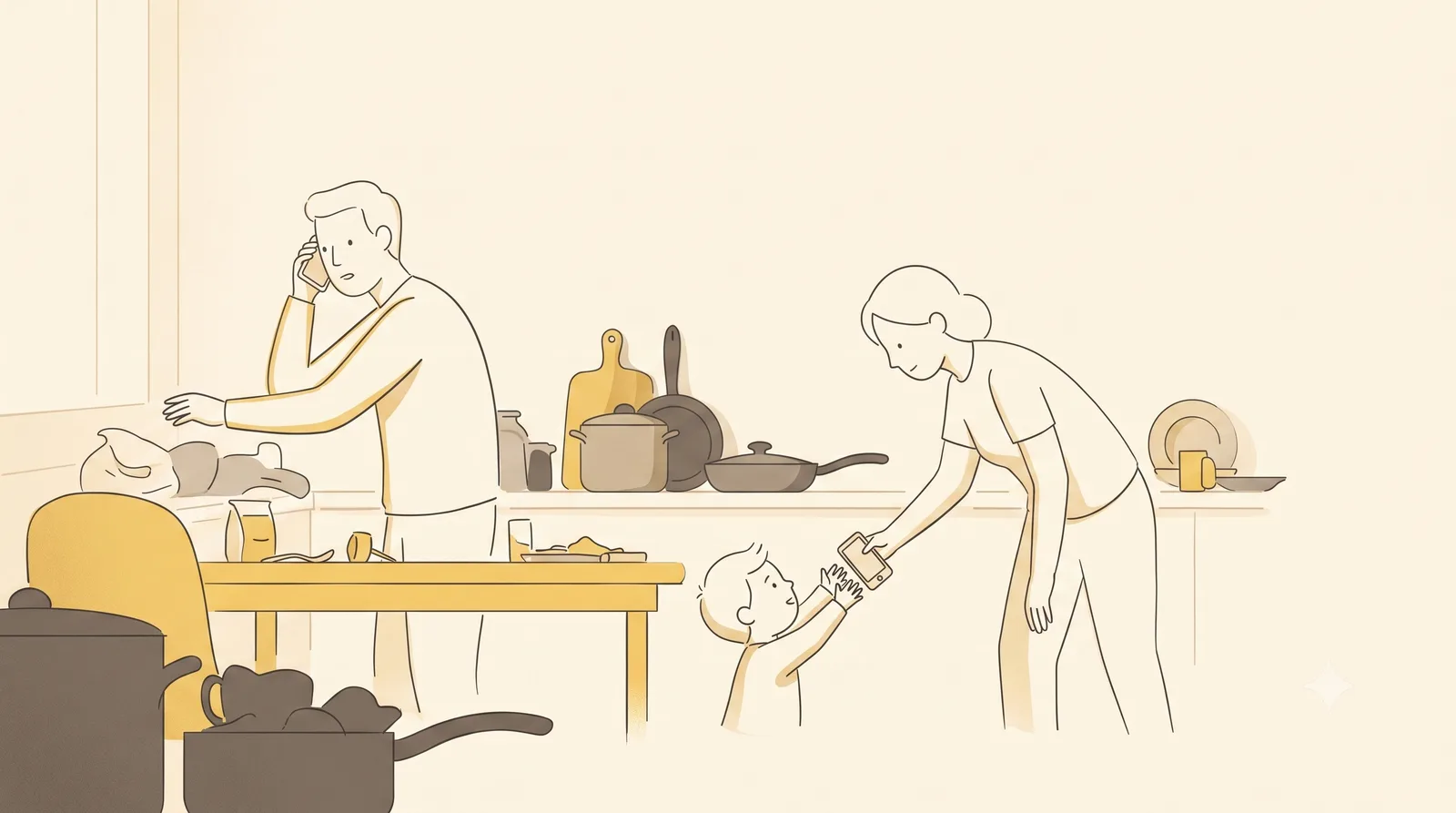
It's half past six. Dinner isn't started, one of you is still on a work call, and the three-year-old has decided this is the moment to come undone. You hand over the phone. Twenty minutes of quiet, and you'll take it.
If you've done this, you've probably also done the thing right after: felt a little bad about it. Most parents do. So let's skip the part where anyone makes you feel worse, and talk about what the guidelines actually say, why your evening rarely matches them, and what you can realistically do inside the life you're already living.
How much screen time should a 2 to 5 year old get?
Here are the actual numbers, because they're worth knowing even if you can't always meet them.
The World Health Organization puts it simply: for children under two, screen time isn't recommended at all. For ages two to four, no more than an hour a day, and less is better. The original WHO guidance is even firmer at the young end, where it lists no sedentary screen time for one-year-olds.
The American Academy of Pediatrics lands in much the same place. Their guidance points to one hour a day of high-quality content for the two-to-five group, ideally watched alongside an adult rather than handed over to fill a gap.
So that's the target. Roughly an hour, good content, an adult somewhere nearby. Hold that number lightly, though, because the people who wrote it would be the first to say it describes a goal, not a verdict on your Tuesday.
Why doesn't real life ever match the guidelines?
Because the guidelines quietly picture a home that very few of us actually have.
They imagine a parent free to sit and co-watch. A second adult to take over when the first one flags. A day with margins in it. Read the recommendations closely and you can almost see the calm living room they were written for.
Now picture an ordinary weeknight instead. Both parents working, one commute eating the early evening, dinner happening in shifts, and nobody spare to step in for the stretch between five and seven when small children fall apart most reliably. In plenty of Indian homes the day has been running flat out since dawn, grandparents help where they can but aren't always around, and the phone becomes the one thing that buys twenty minutes you genuinely need. That isn't a parenting failure. It's arithmetic.
The honest position is somewhere in the middle. The hour-a-day figure is a good star to steer by. Some days you'll sail past it, and the world keeps turning. What matters far more than any single afternoon is the shape of the average week, and even that you can nudge in small ways without rebuilding your whole routine.
What actually helps, without the guilt?
Forget counting minutes to the second. A handful of habits do most of the real work, and none of them asks for a calmer life than the one you have.
Lead with quality over quantity. A slow, gentle show your child follows and chats about is worlds apart from a feed of jumpy clips engineered to keep them hooked. Forty minutes of the good kind beats fifteen minutes of the frantic kind. When you can, pick the content with more care than you count the time.
Co-watch when there's any chance of it. You don't have to sit through the whole thing. Even dropping in now and then, asking "what's happening?", naming the colours, turns passive watching into something the two of you share. Some evenings that's impossible, and that's fine. Aim for some, not all.
For a child too young to read a clock, make time something they can see. A small sand timer, or an alarm with a sound they recognise, turns "screen time is ending" from your decision into the timer's. A pre-reader can grasp "when the sand runs out" far more easily than "in ten minutes", and it spares you being the one who always takes the phone away.
Then alternate. Twenty minutes of a show, then something with hands and bodies in it, blocks, a snack to help with, a quick chase around the room. Breaking screen time into smaller pieces with movement between them is easier on young eyes and on young moods, and it tends to head off the meltdown that comes when a long session ends all at once.
One more, and it's the strongest lever in the lot. Time outdoors. Children who get a couple of hours a day outside are meaningfully less likely to become short-sighted, whatever else fills their day. Outdoor time doesn't just replace screen time; it seems to actively protect growing eyes. A trip to the park isn't only a break from the phone. It's doing real work of its own. (This connects to the wider story of rising short-sightedness in children, where time outside keeps coming up as one of the few things that genuinely moves the needle.) There's more on the daylight side in outdoor time and your child's eyesight.
When is screen time completely fine?
Plenty of the time, honestly. The guidelines aren't trying to wall your child off from screens. They're trying to keep screens from quietly swallowing the whole day. Once you see it that way, whole categories stop counting as the kind of screen time anyone's worried about.
A video call with grandparents who live three states away is one of the best things a screen does. That's connection, faces, real conversation, the very opposite of a child zoning out alone. Nobody's totting that up against the hour, and the AAP doesn't either; back-and-forth video chat sits in a different category from a child scrolling on their own.
A long flight, or a packed clinic waiting room with a fractious toddler and no end in sight, is exactly what the phone is for. A one-off rescue on a hard day is not a habit, and treating it like one only adds stress nobody needs. The thing to watch isn't the occasional long session. It's whether the phone has quietly become the default answer to every flat patch in the day, every single day. That's the pattern worth gently steering, not the rough afternoon.
How do you make the screen time you do allow healthier?
Here's the part most advice skips. If some screen time is happening regardless, and in a real home it usually is, you can make that same time gentler on a child's eyes without cutting a single minute.
Mind the distance first. Young children pull screens right up to their faces, and that close, sustained focus is the tiring part. An arm's length, about 30 cm, is the rough target eye doctors suggest. Propping the phone on a stand rather than letting it drift up to the nose is one of the smallest changes with the biggest payoff, and we go into it properly in our guide to safe screen distance for children.
This is also where a small tool can quietly help. On Android, our own app, Guby, was made for exactly this age group. Rather than nagging anyone about time, it minds the distance: when the phone creeps in too close to a young face, a friendly owl steps in to cover the screen, then slips aside the moment the child moves it back. It doesn't shorten screen time, it just makes whatever screen time happens easier on small eyes, which on a hectic evening is a much smaller ask than "less screen time".
Turn the brightness down too, especially in a dim room where a glaring screen makes young eyes work harder than they need to. Most phones can match the brightness to the light around them automatically; switch that on and let it do the thinking. Warmer, dimmer evenings; brighter daytime. It's a setting you change once and never think about again.
All of this is far easier to set once than to retrofit later, so if a tablet is about to enter the house for the first time, do it on day one — setting up your child's first tablet runs through the whole thing in order, eyes first.
And try to keep screens out of the last hour before bed. The light and the buzz both make winding down harder, and a child who's been absorbed in a bright screen right up to lights-out tends to take longer to settle. Swap the final stretch for a book, or a quiet, dim cuddle. Bedtime usually goes smoother for it, which is reason enough on a tired night.
None of this turns screens into something they're not. It just takes the screen time that's already part of your week and makes it a bit kinder. The aim was never zero. It's slightly better, slotted into the real, busy evening you actually have, with no extra guilt for the privilege.
And if your child is already past five, the advice quietly changes shape rather than simply loosening — how much screen time for a 6 to 8 year old picks the story up from there.
Found this useful?
Send it to a parent who’d want it.
Related reading
The healthy-screen-habits checklist for kids
Seven small habits that protect young eyes, from arm's length to outdoor light to the screen-free wind-down before bed. A checklist you can actually keep.
children's eyes · screen time · screen distance
How far should a child sit from the TV?
Sitting close to the telly won't ruin your child's eyes, despite what your grandmother said. But it can quietly tell you something worth knowing.
children's eyes · screen distance · screen time