Childhood myopia in India: what parents should know
More Indian children are getting glasses younger than ever. Here's what myopia actually is, why it's climbing, and the few things that genuinely help.
On this page
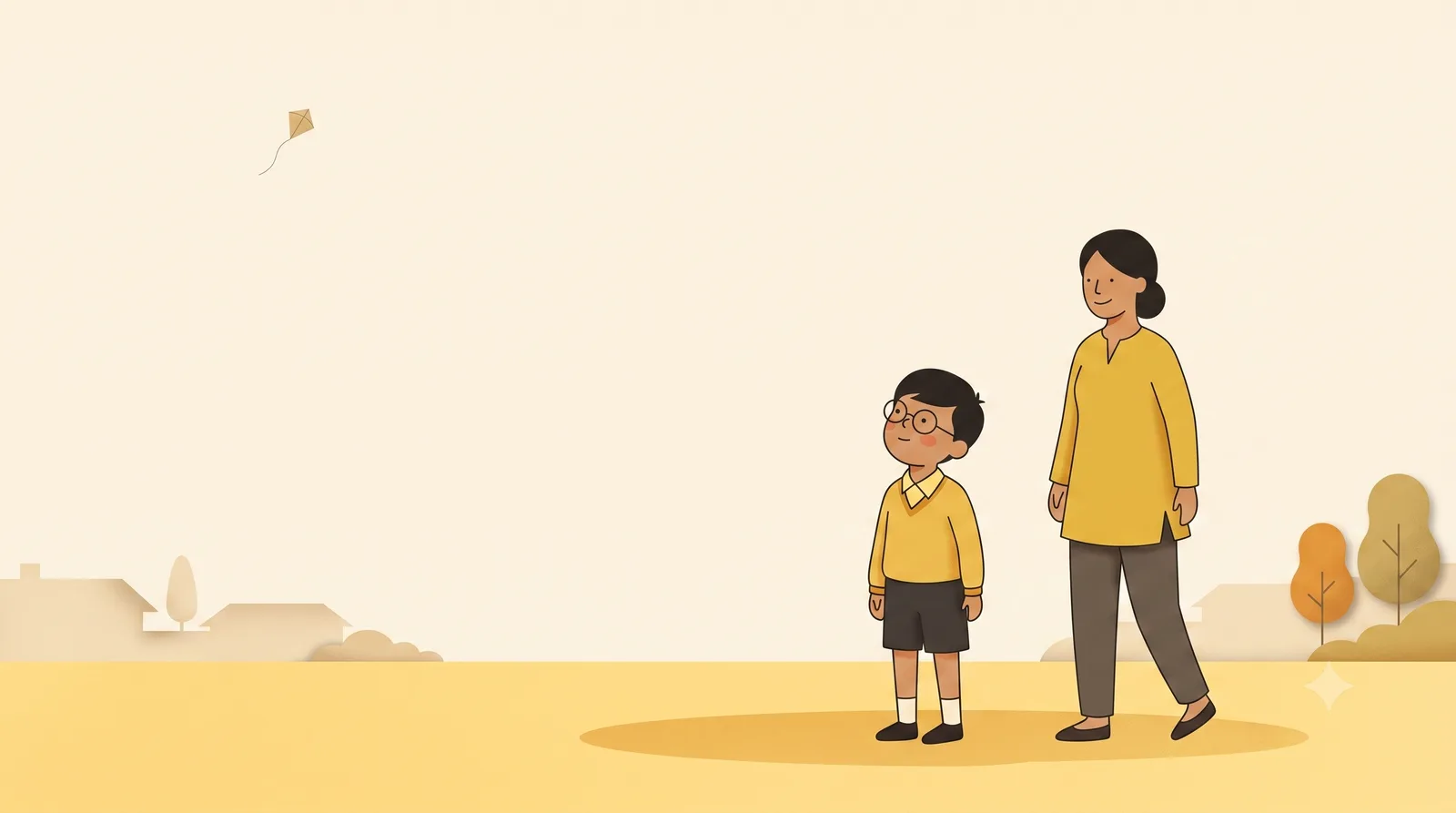
The optometrist looks up from the chart and says your seven-year-old needs glasses. You weren't expecting it. Nobody in the house wore glasses that young, and somehow it feels like it has arrived early. You leave the shop holding a small frame and a slightly heavier head.
If this is you, you are in very ordinary company. More children in India are being fitted for glasses, and younger, than a generation ago. It helps to know what's actually going on, because most of it is calm, manageable, and not your fault.
What is myopia, in plain words?
Myopia is the proper name for short-sightedness, or what most families call "needing glasses for far". A myopic child sees things up close perfectly well, but the world across the room goes soft. The blackboard, the cricket ball, the bus number, all a little blurred.
The mechanics are simpler than they sound. In a myopic eye, the eyeball has grown slightly too long from front to back, so light lands just short of where it should, and distant things won't come into focus. The American Academy of Ophthalmology describes it as exactly that: close-up objects look clear, distant ones look blurry, often because the eye is longer than normal front to back.
It usually begins in childhood. And here's the part worth holding on to: myopia tends to creep, not jump. A child who becomes short-sighted at seven generally becomes a bit more so each year, with the prescription settling somewhere in their twenties. Catching it early doesn't reverse it, but it does let an eye doctor watch the pace and step in if it's moving fast.
Why is myopia rising in Indian children?
This isn't a feeling. The numbers say it plainly.
A meta-analysis of Indian school-children spanning four decades found myopia climbing over time, and a clear gap between city and village: roughly 8.5% of urban children affected against 6.1% in rural areas. More recent work in single cities runs higher still. The STEM study in Tamil Nadu put overall prevalence at 17.5% across more than fourteen thousand children, and by age fifteen, around one in four was myopic.
So the trend is real, and it leans urban. Why? Children in cities spend more of their day indoors and close up, with books, tuition, homework, and screens, and far less of it outside in daylight. That mix of more near focus and less outdoor time is the same shift seen across fast-urbanising parts of Asia, and it points squarely at how children spend their hours rather than at anything in the water or the genes alone.
None of this means a city childhood dooms your child's eyes. It means the everyday rhythm of indoor, close-up life nudges the odds, and that's a rhythm a family can adjust.
What raises a child's risk?
Three things matter most, and only one of them is out of your hands.
The first is family. Myopia runs in families, strongly. When both parents are short-sighted, a child is roughly five to six times more likely to become myopic than a child with no short-sighted parent. That's a meaningful jump. But hold the worry lightly, because about half of children with two myopic parents never become myopic themselves. Genes load the dice. They don't throw them.
The second is near work, which is the close-up stuff: reading, homework, drawing, and screens held a hand's width from the face. Long, unbroken stretches of very near focus are part of what researchers connect to rising myopia. This is also where screens enter the story, less as a villain than as one more thing pulling little eyes in close for hours. Our pillar piece on safe screen distance for children goes deep on the distance side of this.
The third one is the good news, because it's protective and it's well proven. Time outdoors guards against myopia. Across many studies, children who get around two hours a day outside are meaningfully less likely to become short-sighted, and the benefit seems to come from bright outdoor light itself, not from any particular game. Taiwan leaned on this hard, pushing schools to send children outdoors daily, and watched a decades-long rise in childhood myopia start to level off. Daylight, it turns out, is doing quiet work on a growing eye. We've given that finding a piece of its own: outdoor time and your child's eyesight.
What can parents actually do?
Less than you'd fear, and most of it is pleasant.
Start with an eye check. The American Academy of Ophthalmology suggests a child's first proper eye exam around age three if there's nothing obviously wrong, and sooner if there's a family history or anything seems off. This matters in India in particular, because a young child rarely complains that the far side of the room is blurry. They've no idea it's meant to be sharp. They simply walk closer.
So learn the early signs, since your child won't report them. Look out for squinting at the television or the board. Notice if they shift right up to the screen to make something out, or tilt their head to one side, or rub their eyes a great deal, or hold a book almost against the nose. Sitting too close to the TV is the classic tell. We pull these together in signs your child may need glasses, and any of them is reason enough to book an eye doctor, screens or no screens.
Then, the daily levers. Get them outside; that couple of hours of daylight is the steadiest protection going, and it costs nothing but time. Manage the near work too, both how close and how long. Keep screens and books about an arm's length from the face, and break up long sittings so the eyes look up and far every so often. Cutting the total hours helps as well, especially for the youngest, and our notes on screen time for toddlers cover where to draw those lines.
A few tools can lend a hand on the distance side. On an iPhone, Apple's Screen Distance feature dims the screen when the device comes in too close, though its warning is text a young child can't yet read. On Android, our own app, Guby, was built for exactly the two-to-eight years: instead of words, a friendly owl turns up and covers the screen when the phone gets too near, then steps aside the moment your child eases it back. It's a gentle habit-builder for distance, not a treatment, not a medical device, and certainly not a substitute for an eye doctor. Think of any of these as a small nudge, never a cure.
So how worried should you be?
Not very, is the honest answer.
Myopia is common, it's manageable, and a pair of glasses sorts the day-to-day clearly and quickly. What you're really doing in these early years isn't preventing every case, some children are simply built for it, but giving your child's eyes the gentlest possible conditions to grow in. More daylight, a little distance from the screen, a check-up at the right time. And if the prescription is already climbing year on year, there are ways to try to slow that down — myopia control for children walks through glasses, atropine and the lifestyle side.
If your child has just been given glasses, none of this is a verdict on your parenting. Eyes do an enormous amount of changing in childhood, and yours is doing exactly what young eyes do. Keep them outside when you can, keep the screen at arm's length, and let your child's eye doctor watch the rest. That's most of the job, and it's a job most families can do without losing any sleep.
Found this useful?
Send it to a parent who’d want it.
Related reading
Myopia control for children: glasses, atropine, and lifestyle
Your child needs glasses, and now you're hearing words like atropine and ortho-K. Here's what myopia control actually means, and what to ask the eye doctor.
children's eyes · myopia

Outdoor time and your child's eyesight: the two-hour rule
Of everything studied to protect a child's eyes, time outdoors is the strongest. What the two-hour rule means, and how busy families fit it in.
children's eyes · myopia