Outdoor time and your child's eyesight: the two-hour rule
Of everything studied to protect a child's eyes, time outdoors is the strongest. What the two-hour rule means, and how busy families fit it in.
On this page
Your child has been on the floor with a tablet for the better part of an hour, knees tucked up, face close to the screen, completely absorbed in something. You could call them out to the garden, or the lane, or the park down the road. Some afternoons you do. Most afternoons, honestly, the tablet wins.
Here is a reason to tip the balance back. Of all the things researchers have measured in the hope of protecting young eyes, the one that keeps coming out on top is almost embarrassingly simple. It's time spent outdoors. Not a supplement, not a screen setting, not a clever pair of glasses. Just daylight, and quite a lot of it.
Does outdoor play actually improve a child's eyesight?
It won't fix eyes that already need glasses, so let's be clear about that first. A child who is short-sighted will still need their prescription. What outdoor time does is something quieter and arguably more useful: it lowers the chance that short-sightedness, or myopia, takes hold in the first place, and it can slow how fast it climbs once it has.
Myopia is when distant things go blurry because the eyeball has grown a little too long from front to back. It usually starts in childhood and tends to creep up year by year. We go into the full picture in our piece on childhood myopia in India, but the short version is that more children are becoming short-sighted, younger, than a generation ago.
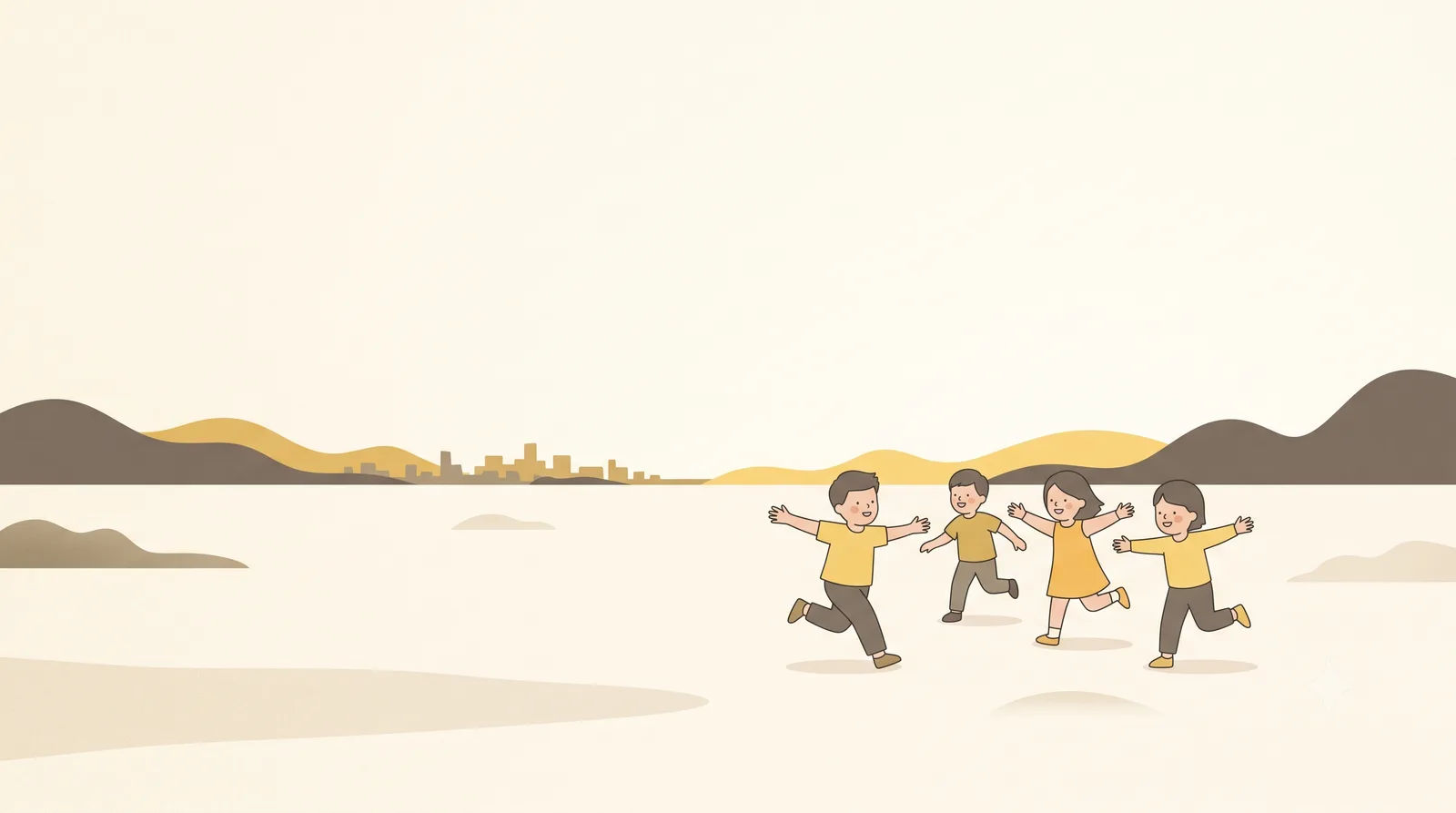
And here is the part that surprised a lot of people, including the researchers. The protection doesn't come from running, or from looking at faraway things, or from any particular game. It comes from the light itself. Being outside in bright daylight appears to do the work, whether your child is playing cricket or simply sitting under a tree with a book.
How much outdoor time does a child need?
This is where the "two-hour rule" comes from, and it's worth knowing where the number actually lands rather than repeating a round figure.
A large meta-analysis of outdoor time and myopia pooled the studies and found a dose you can almost picture. Adding roughly 76 minutes a day outdoors, over and above what children were already getting, was linked to about a 50% drop in new cases of myopia. Put another way, the same analysis estimated that an extra hour a day outside lined up with around a 45% reduction. More daylight, fewer short-sighted children. The relationship held across the studies they could combine.
So when eye bodies and myopia researchers settle on "about two hours a day outdoors", they aren't plucking it from the air. It's the rough total, across school and home, that the evidence keeps pointing to. The American Academy of Ophthalmology frames it for parents as at least one to two hours of outdoor time each day, and adds the mechanism in plain terms: sunlight seems to raise dopamine levels in the eye, and that dopamine helps keep the eye from growing too long. The activity is incidental. The light is the medicine.
Two things make this easier to hear. The two hours don't have to be in one block, and they don't have to be vigorous. A walk to school, a stretch in the park, lunch eaten on a step in the sun, all of it counts toward the total.
What's the evidence that daylight is doing the work?
The single most convincing piece comes from a school in Taiwan, and it's the kind of study that's hard to argue with because it changed one thing and recorded what happened.
In the recess-outside-classroom trial, one school simply sent its children outdoors during every class break, while a nearby school carried on as usual. After a year, the difference was stark. Among children at the outdoor school, new myopia turned up in about 8.4% of them. At the comparison school, it was around 17.7%, roughly double. Same age group, same town, same year of schooling. The main thing that changed was how much daylight the children got, and the eyes followed.
Taiwan didn't stop at one school. The country leaned on this finding as policy, nudging schools across the island to push children outside for around two hours a day. Over the years that followed, a long, steady rise in poor vision among its schoolchildren finally started to level off. One trial can be a fluke. A whole country bending the curve is harder to dismiss.
The light intensity is the quiet hero here. Outdoors on an ordinary day is many times brighter than even a well-lit room, and reviews of the outdoor activity and myopia evidence point to that brightness, rather than any particular sport, as the thing that protects the eye. Which is genuinely freeing, because it means a bookish child who hates sport gets exactly the same benefit by reading on the veranda as the one tearing around the maidan.
How do busy families actually fit two hours in?
This is the honest sticking point. Between school, tuition, homework, the heat in summer, and a city that doesn't always have a safe open patch nearby, two hours can feel like a lot. So treat it as a target to drift toward, not a bar to clear every single day.
Stack it onto things already happening. The walk or cycle to school, if that's an option, is daylight you're getting anyway. Snacks can move outside. Homework that doesn't need a screen can happen on a balcony or a doorstep in the late afternoon when the sun is softer. In many Indian families the easiest two hours are simply the evening play downstairs with the other children in the building, the running-around that used to be the default before screens quietly took the slot.
Weekends carry weight too. A long morning at a park, the grandparents' place with a yard, a temple or market visit on foot, these bank a good chunk in one go and take the pressure off the weekdays. None of it has to look like exercise. It just has to happen under the sky.
And when the tablet does come out, as it will, the indoor habits still matter alongside the daylight. Keeping the screen about an arm's length from the face is the close-up half of caring for young eyes, and our pillar guide on safe screen distance for children covers that in full. For the youngest ones, where the total hours matter most, our notes on screen time tips for toddlers are a gentler place to start.
On the distance side specifically, this is the small job our own Android app, Guby, was built for. When a young child brings the phone in too close, a friendly owl turns up and covers the screen, then steps aside the moment they ease it back, no words to read, just a calm nudge. It minds the distance indoors. It does nothing for daylight, and it isn't meant to. Outdoor time is a separate, bigger lever, and it's one no app can pull for you.
So what should a parent take from all this?
Mostly relief, and one small resolve.
The relief is that the best-proven thing you can do for your child's eyes costs nothing and asks for no expertise. Send them out. An hour here, an hour there, in real daylight, most days of the week. It guards against myopia better than anything you can buy, and your child will probably thank you for the excuse.
The resolve is just to nudge the balance. Not to ban screens, not to hit two hours on a stopwatch, but to let daylight win a few more afternoons than it does now.
One last thing, because eyes are eyes. This isn't medical advice, and time outdoors is no substitute for an eye test. If your child squints at the television, sits unusually close, or you simply have a hunch, book an appointment. Talk to your child's eye doctor, keep them outside when you can, and let the daylight do its quiet work.
Found this useful?
Send it to a parent who’d want it.
Tagged
Related reading
Myopia control for children: glasses, atropine, and lifestyle
Your child needs glasses, and now you're hearing words like atropine and ortho-K. Here's what myopia control actually means, and what to ask the eye doctor.
children's eyes · myopia
6 signs your child might need glasses (and what to do next)
Squinting, sitting too close to the TV, a constant little head tilt. Here are six everyday signs that are worth a mention to your child's eye doctor, and what each one might (and might not) mean.
children's eyes · vision · eye health · myopia