Reading distance for kids: books, tablets, and homework
Holding a book too close strains young eyes the same way a phone does. A simple elbow trick keeps the right distance, no measuring tape required.
On this page
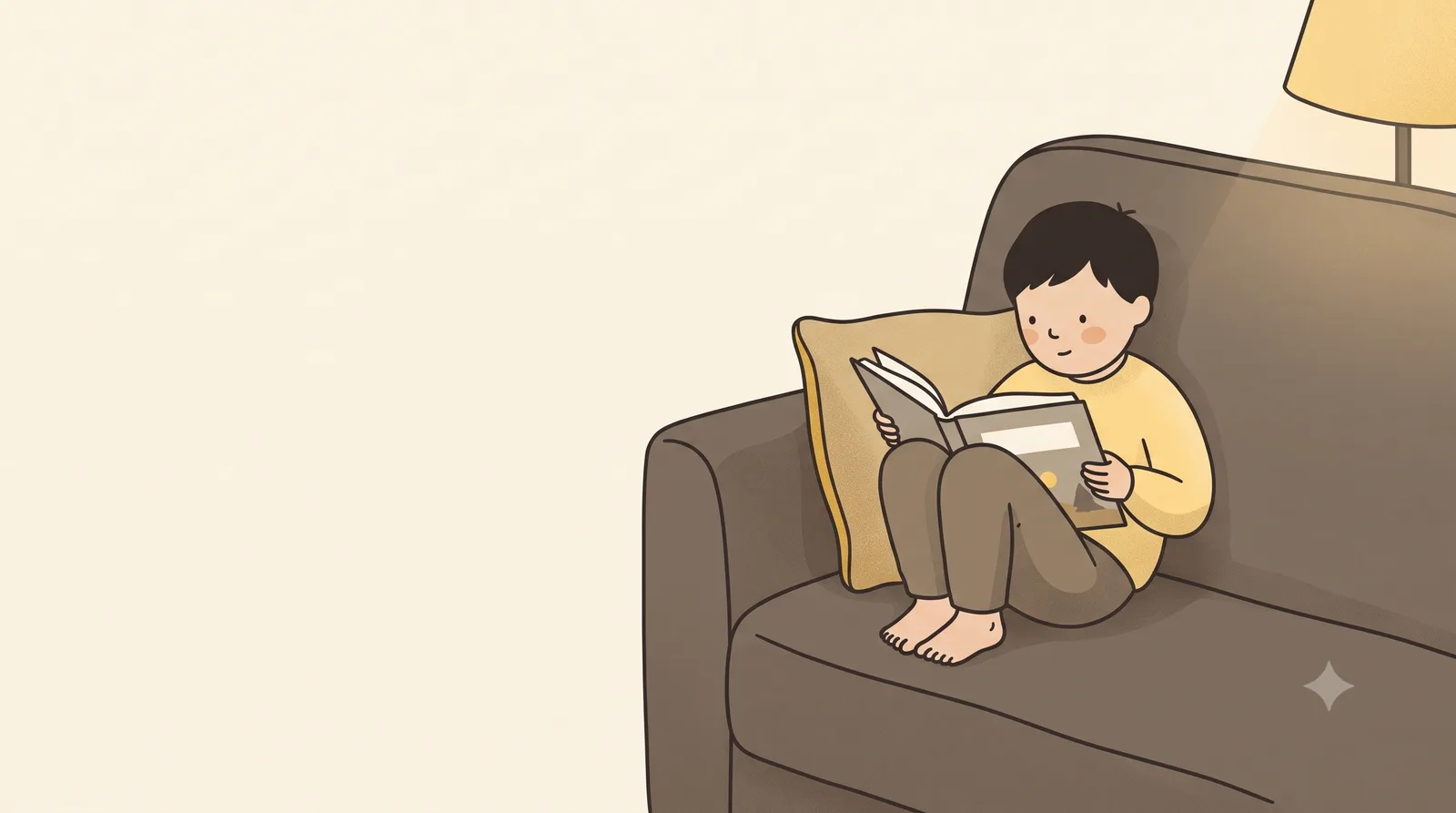
Your daughter is curled on the sofa with a picture book pressed almost against her nose. You ask her to hold it back. She does, for about four seconds, then it drifts in again. Sound familiar?
We talk a lot about how close children hold phones. The same thing happens with paper, and it gets noticed far less, because a book feels wholesome in a way a screen never quite does.
But young eyes do not know the difference. A book held at the nose asks the same hard work of them as a tablet held at the nose. Reading distance is reading distance, whatever the page is made of.
How close is too close when a child reads?
The short answer most eye doctors give is to keep reading material about an arm's length from the face. The American Academy of Ophthalmology, writing about screens, suggests keeping the device an arm's length away and at a slight downward angle from a child's face. That same rough distance works for a book or a worksheet.
For close work in general, optometrists tend to land on a comfortable range. The American Optometric Association's guidance on digital eye strain puts the preferred viewing distance at roughly 20 to 28 inches from the eyes, which is about 50 to 70 cm. A book sits a little nearer than a screen for most people, but the principle holds: not at the nose.
Here is the catch with any fixed number. A toddler's arm is much shorter than a ten-year-old's, so "an arm's length" already shifts with age, which is rather the point. A measurement in centimetres that suits a school-age child is too far for a four-year-old to ever hold.
What is the Harmon distance, and why is the elbow trick so handy?
This is where a lovely old idea earns its keep. It is called the Harmon distance, named after the researcher who studied how children sit and work, and it gives you a personal reading distance without any measuring at all.
You measure it like this. Have your child make a loose fist and rest the knuckles against the chin or cheek, elbow pointing down towards the page. The distance from the eyes to the elbow is roughly how far the book should be. Closer than the elbow, and the eyes are working harder than they need to.
The clever bit is that it scales with the child. As an optometry practice writing about the elbow distance puts it, as we grow, so do our arms, so the same simple gesture fits a five-year-old and a fifteen-year-old. No chart, no ruler, no nagging about exact centimetres.
You do not need to do the fist-and-elbow check every time anyone opens a book. Once or twice is enough to teach the feel of it. After that, a quick "elbows" from across the room is a gentler cue than "you are too close again," and children pick it up surprisingly fast.
Does reading posture and lighting actually matter?
It does, and not in a fussy, sit-up-straight-or-else way. Posture and distance are joined at the hip. A child who slumps or lies flat on the floor with a book under their chin has no real distance left to give, because the page has nowhere to go but towards the face.
So the easy win is the surface. Reading or homework at a table, sitting reasonably upright, naturally parks the page further back than reading sprawled on a bed. The AAO notes that good posture matters too, because poor posture feeds the muscle tightness and headaches that come with tired eyes.
Light is the other quiet factor. A dim corner makes a child lean in to see the words, which pulls the page closer without anyone deciding to. Aim for steady, even light on the page, from the side rather than over the shoulder, and angle screens so the lamp or window does not glare back. The AOA's same digital-strain guidance is firm on avoiding glare from overhead lights and windows, which holds for paper just as well.
Two small things, then. A table beats a bed. A well-lit page beats a shadowy one. Neither costs anything.
How do I set up a homework spot that keeps the distance?
A homework corner does most of the work for you, the same way a phone stand does for screen time. Set the room up once and the right distance becomes the default, instead of something you police every evening.
A few things help. A chair and table at a sensible height, so your child's feet reach the floor and the page sits a little below eye level rather than right up at it. A book stand or a propped folder that tilts the page, so it is not lying flat and pulling the chin down. A reading lamp placed to one side. And, honestly, a clear surface, because a cluttered desk pushes the work into the only free patch, which is usually too close.
For tablet homework, the same setup plus a stand makes a real difference. Propping the tablet at arm's length on the table, rather than holding it in the lap, is the single biggest fix. We dig into the why and the cheap options in our piece on safe screen distance for children, the guide that sits behind this whole cluster.
Then there is the wandering. A child does their maths beautifully at the desk, then carries the tablet to the sofa for a video and folds straight back into the close-up huddle. Furniture cannot follow them around. (The television is the opposite case, by the way: it wants a child to sit back, not lean in.)
That last gap is where a gentle digital nudge helps. On Android, our app Guby was built for exactly this age. It quietly senses the distance between your child's face and the screen, all on the device, with nothing recorded or sent. When the screen drifts in too close, a friendly owl turns up and covers it, then steps aside the moment your child moves back. It is a soft signal a small child understands without a single word of telling-off, and it travels with the phone the way a desk lamp cannot. Useful for the tablet half of homework and the wandering moments after.
When is reading close enough to get checked?
Most of the time, a child who reads too close is just a child being a child, and a calm reminder is all that is needed. Habit, not a hospital visit.
But there is one pattern worth taking seriously. A child who always reads very close, or who seems to need to, even after you have moved the book back many times, may be telling you something with their behaviour rather than their words. Sitting right on top of the page can be the way a young child copes with vision that is not quite sharp.
The optometry practice describing the elbow distance makes the same point: habitually working extremely close can be a bad habit, or it can be a sign of a visual problem worth an exam. The two look identical from across the room, which is exactly why a check is the sensible move rather than more guessing.
This is not medical advice, and one close-up reading session proves nothing. But if the close distance is constant, or it comes with squinting, headaches, rubbing, or holding everything near, it is worth a proper eye test. We have written about the other signs a child might need glasses, and a paediatric optometrist or ophthalmologist can sort out in one visit what no amount of reminding ever will.
So try the elbow trick this week. Set up one decent spot to read and do homework, with a lamp and a chair that fits. Most of the close-up drifting quietly sorts itself out, and the times it does not are exactly the times worth paying attention to.
Found this useful?
Send it to a parent who’d want it.
Related reading
How far should a child sit from the TV?
Sitting close to the telly won't ruin your child's eyes, despite what your grandmother said. But it can quietly tell you something worth knowing.
children's eyes · screen distance · screen time

Setting up your child's first tablet, safely
Before you hand a small child their first tablet, fifteen minutes of setup saves you a hundred small arguments later. Here is the checklist, eyes first.
children's eyes · screen distance · screen time