How far should a child sit from the TV?
Sitting close to the telly won't ruin your child's eyes, despite what your grandmother said. But it can quietly tell you something worth knowing.
On this page
You walk into the living room and your five-year-old has somehow ended up about two feet from the television, nose practically on the screen, completely gone in a cartoon. The voice in your head, the one that sounds a lot like your own mother, says: move back, you'll ruin your eyes.
It's one of the most repeated bits of family advice there is. And it turns out to be, mostly, wrong.
A phone is one problem. The telly is almost the opposite one. A phone gets pulled in too close because little arms are short and a video is interesting; a TV mostly wants the room. So the question isn't quite "how do I keep them back". It's "what distance is sensible, and should I worry when they creep forward". Let's take both.
Will sitting close to the TV actually damage my child's eyes?
Short answer: no. There is no good evidence that it does.
The American Academy of Ophthalmology is about as blunt as a medical body gets on this. In their Q&A on close TV viewing, they say plainly that "there is no evidence that this damages the eyes either in children or adults." The same point shows up in their list of common eye myths, filed firmly under things people believe that simply aren't true.
So where did the warning come from? Partly old televisions. Decades ago, some sets gave off small amounts of radiation, and "don't sit too close" made a bit more sense. Modern screens don't, and the advice outlived its reason, the way these things do.
Here's the part that surprises most parents. Children sit close because they can. The AAO notes that kids "can focus at close distance without eyestrain better than adults", so they happily park themselves right in front of the screen in a way that would give you a headache. For most children, the habit fades on its own as they grow.
The worst a too-close TV usually does is tire the eyes out for a while. Sitting very close for a long stretch can cause eyestrain, a bit of aching or a headache, but that passes after a break. It's discomfort, not damage. Important difference.
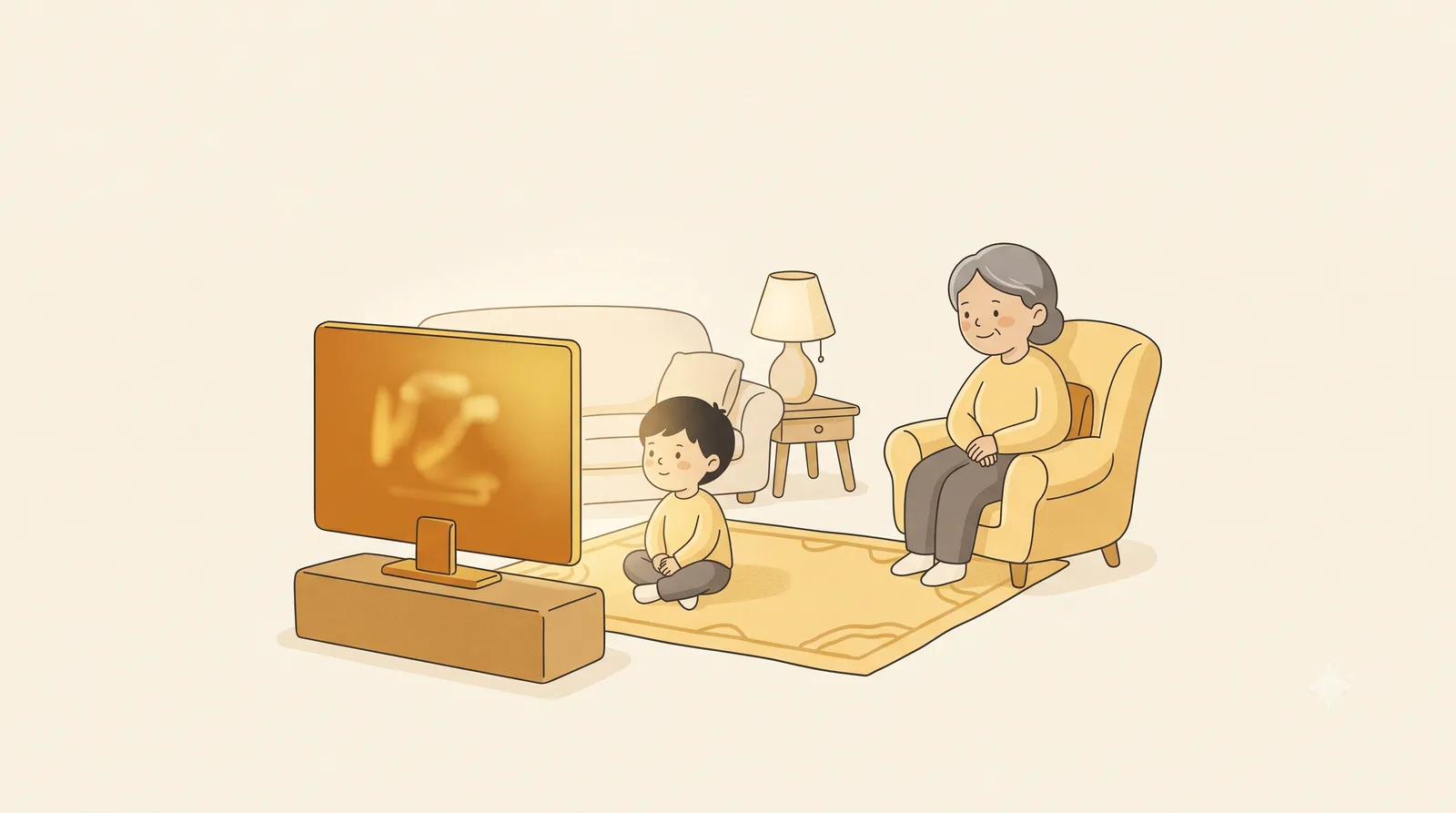
So how far should a child sit from the TV?
Since damage isn't the worry, the goal is plain comfort: far enough that the whole picture sits easily in view without your child having to sweep their eyes across it like they're watching tennis.
There's no official medical number for TV distance the way there is for a phone. The rough guide most people land on comes from the home-cinema world, and it's a sensible one: roughly one foot of distance for every ten inches of screen, measured diagonally. A 50-inch TV, then, sits comfortably around five feet away; a 40-inch one, around four. For most living rooms and most family tellies, somewhere between eight and ten feet is an easy, comfortable spot for a child to settle.
If the sofa is already a normal distance back and your child keeps drifting forward to it, that's the more useful signal, and we'll come to it.
This is a different game from a phone or tablet, where the screen is small and held in the hand and the risk runs the other way, too close rather than too far. For those, eye doctors do give a number: about an arm's length, roughly 30 cm. We go through that in detail in our guide on safe screen distance for children, and the same arm's-length idea carries over to books and homework in our piece on reading distance for kids.
My child keeps sitting right up close. Should I worry?
This is the bit actually worth your attention, and it flips the old advice on its head.
Sitting close doesn't cause a vision problem. But needing to sit close can be an early sign of one. A child who can't see the screen clearly from the sofa will quietly shuffle forward until they can, without ever mentioning it, because to them the world has always looked a little soft and they've nothing to compare it to.
The AAO makes exactly this point: habitually sitting very close to the television may mean a child is short-sighted (myopic) and could need glasses. So the move isn't to scold them back to the sofa. It's to ask why the sofa stopped working.
A few things are worth noticing, gently, over a week or two. Does your child sit close to the TV and hold books or a tablet very near their face? Do they squint, tilt their head, or rub their eyes a lot? Any complaints of headaches, or of things looking blurry? One of these alone usually means nothing. A few together is a nudge to book an eye test.
We've put together a fuller list in our guide to the signs your child might need glasses. If you spot a pattern, the right next step is simple: see an optometrist or a paediatric eye doctor. None of this is medical advice, and a real examination beats any checklist. Children often can't tell you their sight has slipped, so a check-up is how you find out.
Does the room around the TV matter too?
It does, more than the exact distance, honestly.
Glare is the quiet troublemaker. A bright window or a ceiling light reflecting off the screen makes your child work harder to see past it, and that's where real eyestrain creeps in. The American Optometric Association, in its notes on digital eye strain, recommends positioning a screen to avoid glare from overhead lights and windows. For a TV, that often means a small angle change or closing a curtain at the sunny end of the day.
Watching in a pitch-dark room isn't ideal either. A screen blazing in total darkness is a harsh jump for the eyes. A little soft, indirect light in the room, not pointed at the screen, sits more easily. The AAO suggests much the same for children's screen use generally, steering kids away from screens in brightly lit or glary spots.
And breaks help, whatever the distance. The well-known 20-20-20 habit, which the AOA recommends, is to look at something about twenty feet away for twenty seconds every twenty minutes. For a small child who can't read a clock, the real-world version is just the natural ad break or end-of-episode pause: get them up, off to fetch water, a quick look out of the window, then back. The same AAO page above adds the bigger one, that outdoor time in early childhood can actually slow short-sightedness, so a stretch of garden or park does more for young eyes than any seating chart.
It's worth saying the telly is only one screen in the house, and usually the better-behaved one. The hand-held screens are where distance goes wrong far more often, because they travel with the child. On Android, our app Guby was built for exactly that age and that problem: it senses how close a phone or tablet has come to your child's face, entirely on the device, with nothing recorded or sent, and when the screen drifts in too close a friendly owl pops up to cover it, then steps aside the moment they ease back. The TV mostly looks after itself; the phone is the one that needs a quiet hand.
So next time you find your little one perched right under the cartoon, you can let go of the old fear. It isn't hurting their eyes. Move them back to the sofa for comfort if you like, sort out any glare, and keep half an eye on why they wanted to be close in the first place. That last question is the one that actually matters.
Found this useful?
Send it to a parent who’d want it.
Related reading

Setting up your child's first tablet, safely
Before you hand a small child their first tablet, fifteen minutes of setup saves you a hundred small arguments later. Here is the checklist, eyes first.
children's eyes · screen distance · screen time
How much screen time for a 6 to 8 year old?
The toddler rule was simple: about an hour. For school-age kids the official advice quietly changes shape, and most parents never get told why.
screen time · children's eyes