The healthy-screen-habits checklist for kids
Seven small habits that protect young eyes, from arm's length to outdoor light to the screen-free wind-down before bed. A checklist you can actually keep.
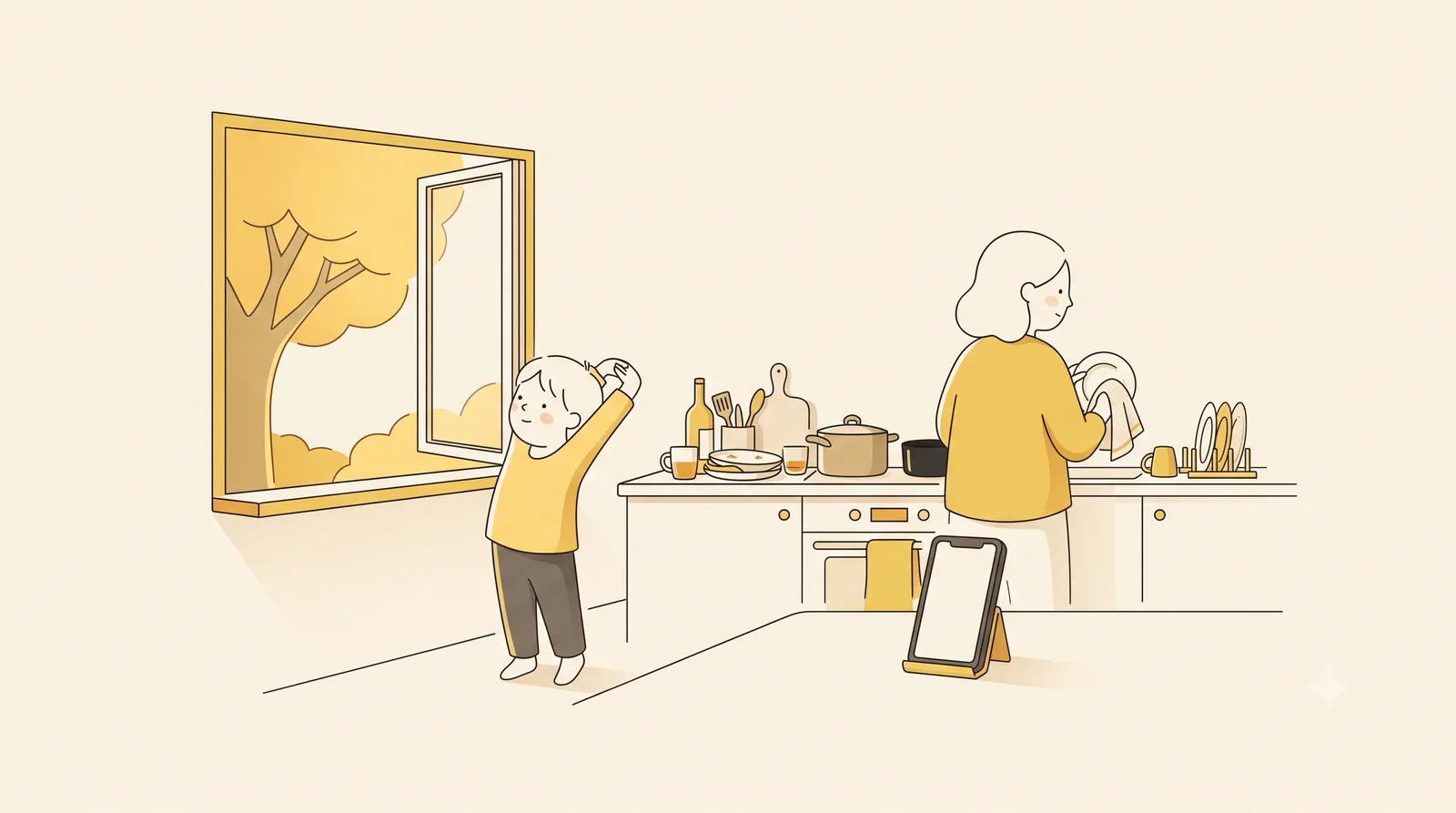
Most evenings it goes something like this. Dinner is half-cleared, the youngest is melting down, and the quickest way to buy ten quiet minutes is a phone with a song on it. You hand it over. You feel a small twinge about it. Then you get on with the dishes.
That twinge is fine. Screens are part of growing up now, and no single video is going to harm anyone. What matters is the shape of the habits around the screen, built up over months, not the odd cartoon on a hard day.
So here is a checklist. Seven habits, each a small thing on its own, that together look after young eyes without turning you into the screen police. None of them is hard. The trick is keeping them, which is mostly about making the easy thing the default.
What are the basics of healthy screen habits?
Think of it as seven points, roughly in order of how much they matter for a child's eyes.
Keep the screen about an arm's length away. This is the big one. A small child will drift the screen closer and closer to their face without noticing, and all that close-up focusing tires young eyes. Most eye doctors suggest roughly 30 cm, about an adult arm's length, as a sensible minimum for a phone. If you want the full reasoning, with the doctor-backed numbers and why little ones drift so close, that is the heart of our guide on safe screen distance for children. The rest of this checklist sits on top of it.
Use a stand instead of holding the device. A propped-up tablet stays where you put it. A held one ends up an inch from the nose. A cheap stand, a cushion, even a leaned book parks the screen at a decent distance and keeps it there, so you are not reminding a four-year-old to sit back every two minutes. We go into the why and the how, including good cheap options, in the case for a phone stand for kids. It is the single laziest fix that actually works.
Build in breaks. Eyes that stare at one fixed distance for a long stretch get tired. The grown-up version is the 20-20-20 rule: every 20 minutes, look at something about 20 feet away for 20 seconds. It was first suggested by an optometrist in the 1990s and is now backed by groups like the American Optometric Association. A pre-reader will not count to twenty, of course, so the trick is to translate it into something a small child can do. We cover the toddler-friendly versions in the 20-20-20 rule for young children.
Get outdoors, ideally a couple of hours a day. This one surprises parents. Time spent outside in daylight is one of the few things shown to lower a child's risk of becoming short-sighted, and the studies point to around two hours a day of outdoor light as the level that helps (American Academy of Ophthalmology). It is not about exercise, it is about the light. A park, a balcony, the walk to school, the after-dinner cricket on the street all count. More on the research in outdoor time and your child's eyesight.
Switch screens off before bed. Screens late in the evening push back sleep, partly because their light tells a young brain it is still daytime. The American Academy of Pediatrics suggests powering down devices at least an hour before bed and keeping screens out of the bedroom where you can. A book and a dim room beat a bright screen every time at bedtime, both for sleep and for tired eyes.
Mind what is on the screen, and how much. The content matters as much as the minutes. The AAP suggests no screen time for children under about 18 months apart from video calls, and up to roughly an hour a day of good-quality stuff for ages two to five, watched together where you can (AAP, Media and Young Minds). The targets shift as children grow. For the under-fives we have screen-time tips for toddlers, and for the older lot, how much screen time for a 6 to 8 year old.
Watch for the warning signs, and keep up regular check-ups. Even with good habits, eyes change as children grow, and a lot of vision trouble shows up quietly. Sitting very close to the television, squinting, rubbing the eyes, complaining of headaches, or tilting the head can all be worth a second look. Our guide on the signs your child might need glasses walks through them. And do not wait for a problem to book an eye test. The AAO and AAP suggest eye checks in the newborn period, at well-child visits through the first year, and again from around age three before school starts (AAO eye screening for children). In India that usually means a paediatric ophthalmologist or an optometrist; our parent's guide to children's eye check-ups explains what each visit involves.
Do I really need to do all seven?
No. That is the wrong way to read a checklist like this.
Pick the two or three that fit your home and make them automatic. For most families the highest-value pair is distance and outdoor time, because those have the clearest link to how young eyes develop. The rest are gentle nudges that add up.
And go easy on the count. A child who watches a bit over the limit on a sick day, or skips outdoor play during the monsoon, is not falling behind. These habits work as an average over weeks, not a score you tick off each night. The aim is a home where the healthy thing is also the easy thing, so you are not negotiating it every single time.
It also helps to know which complaint is normal and which is not. A toddler holding the phone close now and then is ordinary. A child who always sits inches from the television, or whose eyes seem to drift or cross, is worth a doctor's look. There is more on the tired-eyes side of this in eye strain in children, and on the much-hyped worry of blue light and children's eyes, which matters far less than a good night's sleep does.
What about the habit you cannot police: distance?
Six of the seven are things you set up once. The stand goes on the table, the bedtime rule gets agreed, the eye test gets booked. Distance is different. It slips the moment your back is turned, because a small child genuinely does not feel the screen creeping closer.
This is the gap a stand only half-closes, and it is where a little quiet help earns its place. Guby is a free Android app built for exactly this. It uses the phone's front camera, entirely on the device, to sense when the screen has come too close, and a friendly owl steps in to cover it until the child leans back. Nothing is recorded or sent anywhere. It is not a screen-time blocker and not a substitute for any of the other six habits. It just minds the one that will not hold still, so you do not have to keep saying "sit back, love" while the dishes pile up.
For the older children, distance also shows up away from phones, at the homework desk and in front of the television. The same arm's length thinking applies to books and tablets in reading distance for kids, and to the big screen in how far should a child sit from the TV.
None of this is medical advice, and a checklist is no replacement for a real eye doctor. If something about your child's eyes worries you, the rubbing, the squinting, the sitting-too-close that does not ease up, book a check-up and ask. Habits protect. A doctor checks. You want both, and you have made a good start just by reading this far.
Found this useful?
Send it to a parent who’d want it.
Related reading
How far should a child sit from the TV?
Sitting close to the telly won't ruin your child's eyes, despite what your grandmother said. But it can quietly tell you something worth knowing.
children's eyes · screen distance · screen time

Setting up your child's first tablet, safely
Before you hand a small child their first tablet, fifteen minutes of setup saves you a hundred small arguments later. Here is the checklist, eyes first.
children's eyes · screen distance · screen time